Joint kits · 12–36 kV
GXS/1236 three-core XLPE and PVC joint, 12 to 36 kV
Thirteen kit items, eight installation aids, six cable layers the kit has to match. Counted here.
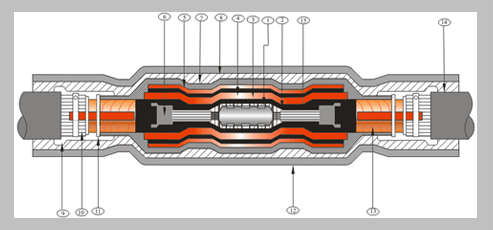
GXS/1236 kV Series straight-through joint
A heat-shrinkable straight-through joint for three-core extruded dielectric cable, shielded, armoured or unarmoured, at 12 kV, 15–24 kV and 36 kV. Supplied as a full kit for one joint. Manufactured by Gala Thermo Shrink Pvt. Ltd.
- Nylon string supplied for cutting back the XLPE insulation
- Solder tack or roll spring for the screen connection — the sheet offers both
- GI mesh application is the published alternative to the wraparound case
| Cable it goes on | 3-core extruded dielectric, shielded, armoured or unarmoured |
|---|---|
| Insulation named | XLPE, EPR or PVC on the catalogue heading; XLPE and PVC on the web page |
| Voltage classes | 12 kV (6.6/6.6, 6.35/11) · 15–24 kV (8.7/15, 11/11, 12.7/22) · 36 kV (19/33) |
| Conductor range | 16–500 sq mm at 12 kV · 25–400 at 15–24 kV · 35–400 at 36 kV |
| Kit codes | GXS-11 to GXS-15, GXS-21 to GXS-25, GXS-31 to GXS-34 |
| Ferrules per kit | 3 inline connection ferrules, one per phase |
| Red insulating tubing | 3 at 12 kV, 6 at 24 kV, 6 at 36 kV |
| Screened tubing | 3 dual wall red-and-black tubes |
| Outer jacketing | 3 sleeves — 1 centre, 2 side |
| Mechanical protection | Wraparound metallic joint case, 1 off; GI mesh application is the published alternative |
| AC withstand, 1 minute | 35 kV · 50 kV · 75 kV by class |
| Impulse withstand, crest | 75 kV min. · 125 kV · 170 kV min. |
| Continuous current rating | As per cable — the kit does not set it |
Read the system pair, not the round number
The sheet keys each class to cable designations, not to a nominal voltage. 12 kV takes 6.6/6.6 and 6.35/11. The 15–24 kV column takes 8.7/15, 11/11 and 12.7/22. The 36 kV column takes 19/33.
That matters more on site than anything else here. A 6.35/11 and an 11/11 are both called eleven kay in the yard. They land on different kits: the first a 12-class GXS, the second a 24-class one. Read the pair off the drum before you read the size.
Construction has to be extruded and screened. Paper cable takes a GPS. A change of construction mid-run takes a GTJ. Below 3.3 kV the family changes to GXLT/GPLT. One wrinkle to settle in writing: the catalogue heading names XLPE, EPR and PVC, while the manufacturer's page for the kit names XLPE and PVC only.
Thirteen items, and what each is counted in
Check the box against this list before anyone touches a hacksaw. A missing side sleeve found at setting-out costs an hour. Found after the ferrule is crimped, it costs a kit.
- Inline connection ferrule — 3, one per phase.
- Stress control mastic — 6/9.
- Heat shrinkable stress control sleeve, black — 3.
- Heat shrinkable insulating tubing, red — 3 on a 12 kV system, 6 on 24 kV, 6 on 36 kV.
- Heat shrinkable dual wall screened tubing, red and black — 3.
- Stress control mastic, grey or yellow — 6 strips.
- Red mastic — 6/9.
- Copper woven flexible mesh tape — 3 rolls.
- Solder tack, or roll spring as the alternative — 1 set, or 3.
- Worm drive clips — 4.
- Wraparound joint case, the metallic protection case — 1. GI mesh application may replace it.
- Heat shrinkable outer jacketing sleeve — 3: one centre sleeve plus two side sleeves.
- Tinned copper braid, main earthing — 1.
Six more numbers on the same drawing are not in the box. Outer sheath, inner sheath, semi-conducting core screen, XLPE insulation, armour, metallic screen in copper foil. Those belong to the cable, and the kit is drawn against them. A wire screen where the sheet assumes foil, or a lead sheath, is a question for the manufacturer — not a smaller code. Item by item across all five series: what a joint kit contains.
Installation aids in the standard kit
| Installation aid | Qty per kit |
|---|---|
| Silicone grease | 3 |
| Mastic sealing tape | 1 roll |
| Nylon string for cutting XLPE insulation | 1 |
| Aloxite emery tape | 3 |
| PVC adhesive tape | 1 roll |
| Mopping cloth | 1 |
| Cleaning tissue | 6 |
| Installation instruction manual | 1 |
Part of the standard packing kit, not a separate order line.
The screen and armour path is five items, not one
Continuity is spread across the manifest rather than bagged together. Three rolls of copper woven flexible mesh tape rebuild the metallic screen across the splice. One tinned copper braid carries the main earthing. Four worm drive clips clamp it. A solder tack, or a roll spring, makes the screen connection.
None of the five can be improvised from the toolbag without changing what the joint was type tested as. Where each lands: how an MV joint goes together.
Electrical performance, as published for GXS/1236
| Test | 12 kV (6.6/6.6, 6.35/11) | 15–24 kV (8.7/15, 11/11, 12.7/22) | 36 kV (19/33) |
|---|---|---|---|
| AC withstand, 1 minute | 35 kV | 50 kV | 75 kV |
| DC withstand, 1 minute | 48 kV | 96 kV | 144 kV |
| Discharge extinction voltage (< 5 pC) | 12.7 kV min. | 25.4 kV min. | 38 kV min. |
| Impulse withstand, crest | 75 kV min. | 125 kV | 170 kV min. |
| Continuous current rating | As per cable | As per cable | As per cable |
From the GXS/1236 pages of the manufacturer's combined joints and terminations catalogue, issue 2 of September 2018.
Those five rows are the series' own. A longer sequence at the back of the same catalogue is declared in compliance with IEC 60502-4 and CENELEC HD 629.1. It adds an impact test and a 63-cycle heating cycle test in water, both marked for straight-through joints. It is not printed inside the GXS pages. Quote it as the range-wide table and ask for the report against your own code. What the type tests prove.
Ordering: conductor size to kit code
| System | Conductor size (sq mm) | Kit code |
|---|---|---|
| 12 kV | 16–50 | GXS-11 |
| 12 kV | 70–120 | GXS-12 |
| 12 kV | 120–185 | GXS-13 |
| 12 kV | 240–300 | GXS-14 |
| 12 kV | 400–500 | GXS-15 |
| 15–24 kV | 25–50 | GXS-21 |
| 15–24 kV | 70–95 | GXS-22 |
| 15–24 kV | 120–150 | GXS-23 |
| 15–24 kV | 185–240 | GXS-24 |
| 15–24 kV | 300–400 | GXS-25 |
| 36 kV | 35–70 | GXS-31 |
| 36 kV | 95–150 | GXS-32 |
| 36 kV | 185–300 | GXS-33 |
| 36 kV | 400 | GXS-34 |
All kits are supplied with full contents for one straight-through joint. Watch 120 sq mm at 12 kV: GXS-12 is printed 70–120 and GXS-13 is printed 120–185. That size reads as both, and the chart gives no tie-breaker. The two higher classes butt up without overlapping.
No source for that
Four things this series does not publish, checked against every Gala datasheet held here, not only the web page. Cable outside diameter: codes are banded on conductor cross-section alone, so a heavy sheath or an oversize armour cannot be checked from print. Setting-out lengths: the same catalogue gives termination tail lengths of 600, 800 and 900 mm outdoor. Nothing equivalent for GXS — no cut-back, no joint length, no overlap. The ferrule: three in the box, no bore, no barrel length, no crimp die. The 6/9 counts: items 2 and 7 carry a slash with no key, while item 4 spells its counts out class by class.
The DC withstand duration is not consistent across the range
GXS/1236 heads its DC column 1 minute at 48, 96 and 144 kV. The single-core and PILC sheets carry the identical three voltages under 30 minutes. One of those durations is a slip and nothing published here says which. Do not put the figure into a type-test clause without the duration confirmed against the code you are buying.
Where GXS stops and GXSS starts
GXSS is not the large end of GXS. The two split on core count. A GXS box holds three ferrules, three stress control sleeves and three screened tubes. It makes one joint on a three-core cable. A GXSS box holds one of each, so a single-core three-phase run needs three kits.
The charts diverge for the same reason. GXS ends at 500 sq mm at 12 kV and 400 sq mm in both higher classes. GXSS runs 16 to 1000 sq mm across all three. Above the GXS ceiling the answer is not a GXSS — it is an enquiry. Side by side on GXSS/1236; the sleeves common to both on the sleeves inside a joint kit.
Next
- GXSS/1236, the single-core joint16 to 1000 sq mm, one core, one ferrule.
- Kit codes against conductor size, all five series
- Every part in a cable joint kit, named
- Six ways a cable joint failsMost of them start at the screen connection.
- Joints that live in water
- The manufacturer's joints range, GXLT to GTJ
Send the cable schedule, not the kit code
Core count. Conductor size in sq mm. The voltage pair off the drum. Screened or not, armoured or not, and how many joints. That reaches a GXS code first time. Kit Sheet is editorial and sells nothing; the kits are made by Gala Thermo Shrink Pvt. Ltd. of Mumbai.