Item 13 in the manufacturer's joints catalogue
GXLT / GPLT straight-through joint, 1.1 and 3.3 kV
One ferrule, one insulation sleeve, one armour continuity connection, one wraparound case. Eleven numbers on the drawing, fourteen if the cable is paper. Six kit codes per voltage class, and the chart is indexed on 4-core sizes only.
GXLT / GPLT series straight-through joint kit
The bottom of the joint range and the only series in it below 11 kV. Two cable ends, one ferrule, one wraparound case, at 1.1 kV or 3.3 kV. Solid dielectric XLPE or PVC, or paper-insulated, armoured or unarmoured, one to four cores including 3½.
- Supplied with full kit contents for making one joint
- Armour continuity carried as a numbered item, not as a loose accessory
- Armour and lead-sheath continuity system on the paper-cable variant
- Oil barrier tubing for lead-sheathed cable
- Galvanised mesh offered as an alternative design replacing the wraparound joint case
- Type tested with the joint immersed in water, not in air
| Voltage classes | 1.1 kV and 3.3 kV |
|---|---|
| Joint type | Straight-through splice, heat-shrinkable |
| Cable construction | Extruded solid dielectric (XLPE / PVC) and paper-insulated, armoured or unarmoured |
| Core counts | 1, 2, 3, 3½ and 4 |
| Kit codes | GXLT-1 to GXLT-6 at 1.1 kV · GXLT-11 to GXLT-16 at 3.3 kV |
| Sizes on the ordering chart | 4x1.5-6 up to 4x300-400 sq mm |
| Numbered items on the drawing | 11 extruded · 14 paper and lead |
| Compliance declared | IEC 60502, IEC 60060, IEC 60230 |
Kit manifest — extruded cable
| No. | Item |
|---|---|
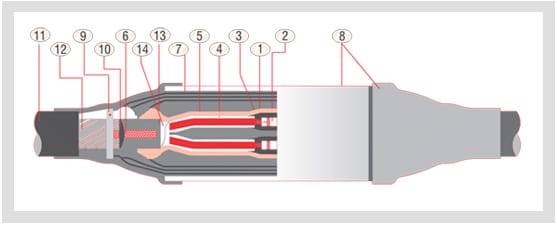
| 1 | Conductor (aluminium / copper) |
| 2 | Inline connector (ferrule) |
| 3 | Insulation sleeve |
| 4 | Armour continuity connection |
| 5 | Worm drive clamps |
| 6 | Cable insulated core |
| 7 | Wraparound joint case |
| 8 | Outer sheath |
| 9 | Cable armour |
| 10 | Inner sheath |
| 11 | Outer jacketing sleeves |
Numbers key to the callouts on the cross-section above. This sheet prints one flat list of eleven and, unlike the GXS and GXO/E sheets, never splits cable components from kit components. Read against the drawing, items 1, 6, 8, 9 and 10 are the cable you are jointing and the other six come out of the box — that split is ours, not the manufacturer's. No quantities are printed against any line.
The paper drawing is a different manifest
Two cross-sections sit under one series head. The second is paper-insulated lead-covered cable and it runs to fourteen numbers.
In printed order: conductor, inline connector (ferrule), insulation sleeve, oil barrier tubing, inner protective tubing, armour/lead sheath continuity system, wraparound joint case, outer jacketing sleeve, cable armour, plumb, outer sheath, armour, lead sheath, paper inner sheath.
Four of those exist nowhere on the extruded list: the oil barrier tubing, the inner protective tubing, the plumb, and the lead sheath the plumb is wiped onto. Nothing on the eleven-item list deals with impregnating compound.
Read the numbering as printed and you will find armour twice, at 9 as cable armour and again at 12. Both are on the sheet. Neither is a second component.
Where the earth path goes
Continuity is the half of this kit that gets skipped, and it is the half a fault current cares about.
- Armour continuity connection, item 4 on the extruded drawing. It is a line on the manifest, so it is in the box; check it against the drawing before you cut back.
- Worm drive clamps, item 5 — jubilee clips, one each end, holding the continuity down onto the armour bed.
- Armour/lead sheath continuity system, item 6 on the paper drawing. Two metallic paths to bridge there instead of one, which is why the item is named differently.
- Plumb, item 10 on the paper manifest. That single word decides whether the job needs a jointer who has wiped a lead sheath before.
- Oil barrier tubing, item 4 on the paper manifest and listed by the manufacturer as an option for lead-sheathed cable. What it bars is the compound in the paper.
- Galvanised mesh replaces the wraparound joint case. The sheet calls it an alternative design, prints no separate code for it, and leaves it at that — so ask for it by name at order stage.
- No stress control item appears on either list. There is no insulation screen to grade at these classes, which is why this manifest is eleven lines and a GXS/1236 kit needs thirteen kit components before the aids.
Ordering information — code by cable size
| Cable size (sq mm) | Kit code, 1.1 kV | Kit code, 3.3 kV |
|---|---|---|
| 4x1.5-6 | GXLT-1 | GXLT-11 |
| 4x10-16 | GXLT-2 | GXLT-12 |
| 4x25-50 | GXLT-3 | GXLT-13 |
| 4x70-150 | GXLT-4 | GXLT-14 |
| 4x185-240 | GXLT-5 | GXLT-15 |
| 4x300-400 | GXLT-6 | GXLT-16 |
Same physical family across both columns; the leading 1 in the second column is the 3.3 kV class. Sizes are printed as 4-core throughout.
Two versions of this chart are in circulation
The joints and terminations catalogue prints six rows per class and ends at 4x300-400 sq mm with GXLT-6 and GXLT-16. The manufacturer's own web page for the same kit stops at GXLT-5 and GXLT-15, and gives its top size as 4x185-400. The table above follows the catalogue, because that is the document carrying the chart in full. Confirm the top two codes in writing before either goes onto an order.
Type test record, as printed
| Test | Parameter for evaluation | 1.1 kV | 3.3 kV | Result |
|---|---|---|---|---|
| Insulation resistance | 1 min, 500 V DC | — | — | >10³ Ω |
| AC high voltage test, joint immersed in water | 5 min | 3.5 kV | 6 kV | No breakdown and no flashover |
| Impulse withstand at ambient temperature | 10 positive and 10 negative | 8 kV | 12 kV | No breakdown and no flashover |
| Insulation resistance | 1 min, 500 V DC | — | — | >10³ Ω |
| Heating cycle test in water (straight-through joint) | 63 cycles in water, 5 hours heating and 3 hours cooling, conductor at 95 °C | — | — | No breakdown and no flashover |
| Insulation resistance after impact test (immersed) | 1 min, 500 V DC | — | — | >10³ Ω |
| Impulse withstand at elevated temperature | 10 positive and 10 negative, conductor 95 to 100 °C | 8 kV | 12 kV | No breakdown and no flashover |
| DC high voltage test (dry) | 5 min | 15 kV | 21 kV | No breakdown and no flashover |
Headed Guaranteed Technical Particulars in compliance with IEC 60502, 60060 & 60230. The two voltage columns are Umax for the class. Insulation resistance is printed as >10³ Ω and the exponent does not survive legibly in the published PDF — read it off a fresh copy before you quote it in a schedule.
No source for these
Which prefix is which. GXLT and GPLT are printed as one series head and nothing on the sheet says which construction takes which letter. Anything below four cores. The description covers 1, 2, 3, 3½ and 4-core; the ordering chart is indexed only on 4-core sizes, with no row for a 3-core, twin or single-core cable. Ask which code covers yours. Quantities. The GXS, GXO/E and GTJ sheets all carry a Qty. column against every line. This one does not, so the manifest above gives you names and no counts. Finished length, recovered diameter, cure temperature, shelf life, price, lead time. None of it is published in anything we hold — the same gap set out on what a cable joint has to put back. Ask the manufacturer, and get the answer in writing.
When this is the wrong kit
Above 3.3 kV, stop. The series ends there and nothing in it is graded for a screened cable. Three-core XLPE at 12 kV and up is GXS/1236; single core is GXSS/1236; three-core paper at 11 kV and above is GPS; paper coming onto XLPE is a GTJ transition joint.
A tee off a distribution main is not this kit either. A straight-through takes two ends into one case. Tees and breakouts are a different job with a different manifest.
And if the work in front of you is a pair of conductors inside a panel or a fitting, this is far more kit than the job needs. Cover the joint and get on.
One filing quirk worth knowing before you search. The manufacturer catalogues this series as a splicing kit and files it under MV cable joints, even though 1.1 kV and 3.3 kV sit below anyone's definition of MV. Search either way and you land in the same place.
Send the cable, not the code
Construction, core count, conductor size in sq mm, system voltage, armoured or not, and whether the run sits in water. Six facts, and the code comes back in one reply instead of five.