Kit components
The sleeves inside a GXS, GXSS, GPS or GXLT joint kit
Five classes of tube, the material each is made from, and the count that moves with voltage class.
Five classes, and the kit code each one arrives in
Six joint series in this range carry heat-shrink sleeving, and no two carry the same set. GXLT/GPLT at 1.1 and 3.3 kV. GXS/1236 for three-core XLPE, EPR or PVC. GXSS/1236 for single core. GPS/1112 and GPS/2436 for paper. GTJ where paper meets XLPE. Between them the sleeving falls into five classes: stress control, red insulating, dual-wall screened, oil barrier and outer jacketing.
None of the five is optional and none is chosen. What arrives is decided by the cable — whether it has an insulation screen to cut back, whether its insulation is oil-impregnated, and how many cores go through the box. Then the voltage class moves the counts inside a series that has already been picked.
So the name is the same across four series. The quantity, the wall and the voltage class behind it are not.
What each class is doing in there
- Stress control tubing
- Recovers over the screen cut-back and the ferrule region.
GXS/1236prints it as a heat shrinkable stress control sleeve, black, three per kit — one per core.GXSS/1236and bothGTJsheets call the same item stress control tubing. It never ships alone. A mastic of the same name fills the physical step first, so the tube is never asked to bridge a void. - Red insulating tubing
- Puts back the insulation the cut-back removed. Red on every sheet in the range that names a colour, so a jointer asks for the reds and not for item 4. This is the one class whose count changes with system voltage inside a single series.
- Dual-wall screened tubing
- One tube doing two jobs. An insulating inner layer and a semi-conductive outer layer, co-extruded, so the insulation screen crosses the joint without a second wrap.
GXS/1236writes it Red+Black andGPS/2436writes it Black+Red. Both sheets name separate insulation and conducting tubings as the published alternative. - Oil barrier sleeve
- Paper cable only. It stops impregnant migrating along the core out of the paper side. That is also why the
GTJinline connector is a barrier type and not a plain crimp. AGTJ/2436carries three of them.GPS/1112lists two separate oil barrier lines plus an internal protection sleeve that appears on no other joint sheet. - Outer jacketing sleeve
- The last item on and the only sleeve that lands on the original cable oversheath.
GXS/1236supplies three of them — one centre and two side sleeves — whereGXSS/1236supplies one. OnGPS/1112the same line reads heat shrinkable adhesive lined outer jacketing, with the lining stated on the sheet.
Nineteen callouts, and five of them are sleeves
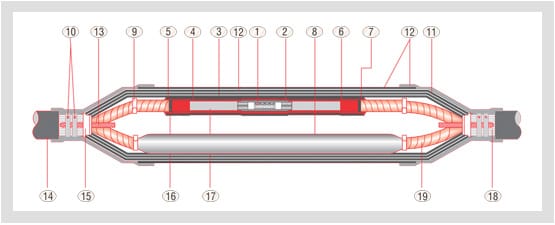
The GPS/1112 drawing numbers nineteen callouts around a finished 11 kV joint on three-core paper cable. Items 15 to 19 are marked as installation aids, so fourteen are components you keep.
Five of those fourteen are sleeving. Adhesive lined outer jacketing at 1, oil barrier sleeve at 7, insulating tubing at 8, internal protection sleeve at 9, oil barrier sleeves at 12. Everything else is a ferrule, a mesh, a mastic, a wedge, a separator or a tape.
That ratio holds across the range. The sleeves decide whether the joint holds volts, and they are always a minority of the box.
Insultube-Red — heat-shrink red insulation tube, GRT series
The red insulating tubing has its own published sheet, separate from any kit. Cross-linked polyolefin conforming to IEC 60684-3-247, halogen free and RoHS compliant, described there as used in power cable joints for MV applications. Three wall grades and nine diameters, against a technical qualification report numbered QR 1036.
- Nine standard-wall codes, GRT 30/8 to GRT 130/36
- Heavy wall GRT(HW) over the same nine diameters
- Extra heavy wall GRT(EHW) from 50/16 upwards only
- Customised dimensions, thickness, length and colours offered on request
| Dielectric strength | 22 kV/mm min. (ASTM D149) |
|---|---|
| Volume resistivity | 1 × 10¹⁴ Ohm.cm min. (ASTM D257) |
| Dielectric constant | 5 max. (ASTM D150) |
| Tensile strength | 12 N/mm² min. (ASTM D638) |
| Ultimate elongation | 300 % min. (ASTM D638) |
| Longitudinal change | −10 % max. (ASTM D2671) |
| Hardness | 45 ±10 Shore D (ASTM D2240) |
| Water absorption | 0.2 % max. (ASTM D570) |
| Shrink temperature | 125 °C (IEC 216) |
| Continuous temperature limit | −40 to +110 °C |
| Heat shock, 250 °C for 30 min | No cracking or flowing (ASTM D2671) |
| Low temperature flexibility, −40 °C for 4 h | No cracking (ASTM D2671) |
| After ageing at 120 °C for 500 h | 11 N/mm² and 250 % elongation, both min. (ASTM D638) |
Insultube Double Layer — dual-wall screened tubing, GDLT series
The screened tube, published on its own sheet as an insulating inner layer and a semi-conducting outer layer made by co-extrusion, for straight-through joints up to 36 kV. Standard colour black/red. Read its shrink figures twice before setting a gun. The feature list gives 100 °C to start recovery and 130 °C to recover fully. The specification table on the same page prints 135 °C to IEC 216.
- Eight codes, GDLT 30/11 to GDLT 120/45
- Recovered wall 5.0 ±0.3 mm to GDLT 65/27, then 7.0 to 7.5 mm
- Inner layer insulating, outer layer semi-conductive at 1 × 10³ Ohm.cm
- Named on the kit sheets as the alternative to separate insulation and conducting tubings
| Dielectric strength, inner layer | 20 kV/mm min. (ASTM D149) |
|---|---|
| Volume resistivity, inner layer | 1 × 10¹⁴ Ohm.cm min. (ASTM D257) |
| Volume resistivity, outer layer | 1 × 10³ Ohm.cm min. (ASTM D257) |
| Tensile strength, each layer | 12 MPa min. (ASTM D638) |
| Ultimate elongation, each layer | 300 % min. (ASTM D638) |
| Hardness | 50 ±3 Shore D (ASTM D2240) |
| Water absorption | 0.5 % max. (ASTM D570) |
| Continuous temperature limit | −40 to +100 °C (IEC 216) |
| Heat shock, 250 °C for 30 min | No cracking or flowing (ESI 09-11) |
| After ageing at 120 °C for 500 h | 10.5 MPa and 270 % elongation, both min. (ASTM D638) |
GRT selection chart, all three wall grades
| Code | D min. (mm) | d max. (mm) | Standard T (mm) | GRT(HW) T (mm) | GRT(EHW) T (mm) |
|---|---|---|---|---|---|
| GRT 30/8 | 30 | 8 | 2.6 | 3.0 | — |
| GRT 33/10 | 33 | 10 | 2.6 | 3.0 | — |
| GRT 40/12 | 40 | 12 | 2.7 | 4.0 | — |
| GRT 50/16 | 50 | 16 | 2.7 | 4.0 | 6.2 |
| GRT 70/22 | 70 | 22 | 2.7 | 4.0 | 6.2 |
| GRT 95/25 | 95 | 25 | 3.0 | 4.0 | 6.2 |
| GRT 105/30 | 105 | 30 | 3.0 | 4.0 | 6.2 |
| GRT 115/34 | 115 | 34 | 3.2 | 4.0 | 6.2 |
| GRT 130/36 | 130 | 36 | 3.2 | 4.0 | 6.2 |
From the manufacturer's Insultube-Red sheet. D is the internal diameter as supplied, minimum; d is the recovered internal diameter, maximum; T is the recovered wall to ±10 %. Extra heavy wall starts at 50/16, so the three smallest diameters have no EHW code.
Which sleeve, in which kit, and how many
| Sleeve class | GXLT/GPLT 1.1–3.3 kV | GXS/1236 three core | GXSS/1236 single core | GPS/2436 paper | GTJ/2436 transition |
|---|---|---|---|---|---|
| Stress control tubing | — | 3 | 1 | Named, no quantity | 3 |
| Red insulating tubing | Insulation sleeve, no quantity | 3 at 12 kV, 6 at 24 and 36 kV | 1 at 12 and 24 kV, 2 at 36 kV | Named, no quantity | 6 at 15–24 kV, 9 at 36 kV |
| Dual-wall screened tubing | — | 3 | 1 | Named, no quantity | 3 |
| Oil barrier sleeve | Oil barrier tubing, paper drawing only | — | — | Named, no quantity | 3 |
| Compression tubing | — | — | — | — | 3 |
| Adhesive-lined side sleeve | — | — | — | Named, no quantity | 2 |
| Outer jacketing sleeve | Named, no quantity | 3 — one centre, two sides | 1 | Named, no quantity | 1, centre |
Quantities exactly as printed on each kit's bill of material. A dash means the class is absent from that sheet's published list. The GXLT/GPLT and GPS/2436 sheets are callout legends with no quantity column at all, so those cells say what is named rather than how many arrive. The GTJ/2436 insulating row follows the printed catalogue; that sheet's web page names the same item screened tubing instead, and the manifest page sets the disagreement out.
The stack, and the mistake nobody undoes cheaply
The sleeves are concentric, so their order is geometric rather than procedural. Mastic into the step at the screen cut. Stress control tube over the graded length. Red insulating tube over that. Dual-wall screened tube over that, semi-conductive face outwards, so the screen it rebuilds sits where the cable's own screen sat. Mesh, braid and case after all of it. Outer jacketing last, landing on oversheath at both ends. The GXS/1236 list runs roughly in that order, though the mastics and the earth braid sit where the packer put them rather than where you reach for them.
Thread every one of them onto the cable before the ferrule is crimped. A crimped barrel is wider than the core it sits on, and no tube in the kit will recover back over it. So a tube left in the carton costs you the connector, the cut-back and some cable length. Each kit is supplied complete for one joint and no more.
The full stage-by-stage order, including where the armour and screen continuity is picked up, is on the installation sequence page. The instruction manual packed with the kit governs over anything written here.
Adhesive-lined against plain, and one name that catches people
Only the outermost sleeving is described as lined. GPS/1112 item 1 is heat shrinkable adhesive lined outer jacketing; GPS/2436 item 12 and GTJ item 13 are both adhesive lined side sleeves, two per transition kit. The inner three classes — stress control, red insulating, dual-wall screened — are printed plain on every joint sheet in the range.
What the adhesive has to hold is the interface between the joint body and the original cable oversheath, which is the path water takes. The GXLT/GPLT type tests are run on that assumption: the AC high voltage test is done with the finished joint under water. Five minutes at 3.5 kV on a 1.1 kV kit, 6 kV on a 3.3 kV one. The heating cycle test then runs 63 cycles in water, conductor at 95 °C.
One name collision is worth spelling out, because both products are made by the same manufacturer. Dual wall in a joint kit means the GDLT tube above: insulating inside, semi-conductive outside. Dual wall in the general tubing range means GDW: polyolefin co-extruded with hot-melt adhesive, 3:1 and 4:1 shrink ratios, GDW 3/1 up to GDW 50/17. That one is sold for wire splices and harness sealing. Same two words, entirely different second wall. Put a GDW where a GDLT belongs and you have glued the joint you were supposed to screen.
The 66 kV line on the red tube, and where the kits actually stop
The manufacturer's component index describes the red insulation tube as insulating a joint area to 66 kV, and says the same of the non-tracking and the stress control tube. No joint kit in this range goes there. GXS/1236, GXSS/1236, GPS/2436 and GTJ/2436 all stop at the 36 kV class, tested at 19/33 kV. The GRT sheet itself publishes no voltage rating at all — only 22 kV/mm dielectric strength, which is a material property and not a system voltage. Treat the 66 kV figure as a statement about the compound, never as a kit you can order.
No source for that
Three questions a specifier reasonably asks about these sleeves, and the published record answers none of them. Which tube code sits in which kit. GRT and GDLT each publish a selection chart. The kit bills of material name the sleeves and never map a kit code to a tube code, so nothing here says a GXS-12 holds a GRT 70/22. Sleeve length. Diameters and recovered wall are published on both sheets; no length is, anywhere. Shelf life of a pre-expanded tube. Not stated for any item in the range. Ask the manufacturer with the kit code and the voltage class in the message.
A sleeve on its own is not a joint
A GXSS/1236 bill of material runs to eleven numbered kit components and four of them are sleeving. A GTJ/2436 runs to twenty, of which eight are tubing or sleeve lines. The rest is a ferrule, mastics, copper mesh tape, GI mesh, earth braid, a void filler, an EPDM wedge, springs, jubilee clamps, a joint case and plumbing metal. Order the tube alone and every one of those lines is still somebody's problem.
Two other things called sleeves are outside this page on purpose. General-purpose heat-shrink tubing is a material bought against a supplied and a recovered diameter, and carries no kit code — that sizing rule is a different calculation. A wrap-around repair sleeve closes over a damaged oversheath with the cable left lying where it is. It makes no electrical joint at all, and sits under the four joint types as the one that is not one.
Where this goes next
- Every part in a cable joint kit, namedThe whole manifest, sleeves included, with the accessories and the aids list.
- Cable joint kit size chartConductor area in, kit code out, series by series.
- Which joint kit series fits the cableInsulation, core count and voltage class, in that order.
- GXS/1236 three-core XLPE and PVC jointWhere the 3-at-12-kV and 6-at-24-kV red tube counts come from.
- GXSS/1236 single-core jointOne core, one of nearly everything, 16 to 1000 sq mm.
- GTJ transition joint, PILC to XLPEThe kit with oil barriers and compression tubing on the same list.