Wire joints
Four ways to cover a finished wire joint
The connection is made off. Now decide what goes over it, and whether a cover is enough.
Exposure picks the cover, not voltage
Four things get used over a made-off joint. Butyl mastic tape. An adhesive-lined heat-shrink sleeve. A moulded cap. A rubber or EPDM cold-shrink part.
Three of those are catalogued items in the manufacturer's cable joint component range. The fourth, the moulded cap, is catalogued for a different job, and that matters more than anything else here.
Do not treat the four as alternatives before reading a kit list. A GXS/1236 kV joint kit carries mastic sealing tape, red insulation tubing and an outer jacketing sleeve in the same box, at separate item numbers. That is not four ways to do one thing.
The four, side by side
Read the last column first.
| Cover | What it actually is | Where it holds | What defeats it |
|---|---|---|---|
| Butyl mastic tape | Cold-applied butyl sealant, an accessory in the joint component range | Under another cover, filling the void that cover cannot close | Being asked to be the cover. No ingress rating is published for tape alone |
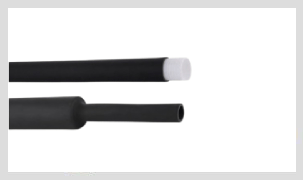
| Heat-shrink sleeve | Medium or heavy wall cross-linked polyolefin tube, adhesive lined | Straight-through joints and connectors, published up to 3.3 kV | Under-shrinking, and a recovered bore that never closes on the cable |
| Moulded cap (Insulcap GEC) | Adhesive-lined moulded cap for a cut cable end, GEC 001S to GEC 1101 | A cable end you are not jointing. A spare core left in the pit | Being reached for at a joint. It is published as an end seal |
| Rubber or EPDM cold shrink | Cold shrink tubing and breakouts in EPDM, free of chloride and sulfur | Sites with no torch and no hot-work permit | Having no published test data in this range. See the block below |
Each one, in the order you reach for it
1. Butyl mastic tape
The tape in these kits is a cold-applied butyl sealant, not the self-amalgamating rubber tape most people mean by joint tape. No self-amalgamating tape has a datasheet in this range, so this page claims none. Mastic fills voids and seals steps. On the GTJ/2436 installation-aids list it is item 6, two rolls. Stress-relief mastic is a separate item again, six pieces, and it goes at the connector.
2. Adhesive-lined heat-shrink sleeve
Medium and heavy wall tube is what the range offers here. The published wording is that it protects LV and MV joints and insulates connectors for straight-through joints up to 3.3 kV. Note the ceiling. Slide every sleeve on before you crimp, because there is no second chance once the connector is made off. Where nothing can be threaded on, the wraparound repair sleeve works from the side: 3:1 shrink, flame retardant and self-extinguishing, hot-melt lined to IP68, GMRS-19 to GMRS-250 for 5 to 192 mm cable OD.
3. Moulded cap
The moulded cap people search for is Insulcap, and Insulcap is an end cap. It is published as sealing the ends of all types of cable against ingress of water and moisture, which means closed at one end. Cross-linked polyolefin, hot-melt lined, IP68, dielectric strength 12 kV/mm to ASTM D149. The chart gives Ds, Df, Ls and Tf from GEC 001S to GEC 1101. Good over a spare core or a drum end. Check the Insulcap datasheet before ordering one for a joint.
4. Rubber or EPDM
The range does carry rubber. Cold shrink tubing and a cold shrink breakout are both listed in EPDM, free of chloride and sulfur, and a GTJ/2436 transition joint holds an EPDM insulating wedge at item 14. That is the whole published record. No dielectric figure, no temperature range, no ingress rating, no selection chart. If a number has to go into a schedule, rubber cannot give you one here.
Two issues of the end cap chart do not agree
Two issues of the Insulcap selection chart are published and they differ at the small end. One gives GEC 001S a 2.5 to 4 mm cable range and GEC 001 a 5 to 8 mm range. The other gives 2 to 4 mm and 4 to 8 mm for the same codes. Sizes above GEC 101 agree. Work to the sheet that came with the goods.
No source for that
Four things this page will not tell you, because the manufacturer does not publish them. Any performance figure for the cold shrink rubber. Shelf life of a pre-expanded part. How long the job takes on site. Price, lead time, minimum order or stock. Ask for those in writing rather than taking them off a website, this one included.
Adhesive-lined against plain, and when plain is worse than nothing
Every IP68 claim in this component range hangs on a hot-melt adhesive lining, never on the tube. The end cap, the cable repair sleeve and the Insulsleeve wraparound all word it the same way. The adhesive provides the seal.
The branch off clip shows the mechanism plainly. Its hot melt lining melts as the outer sleeve shrinks, sealing both cores in place as the sleeve comes down. Three sizes, GBOC 1 to GBOC 3, dielectric strength 12 kV/mm to ASTM D149.
Now the case against a plain tube. Shrink an unlined sleeve over a joint in a wet duct and you have built an annulus. Water walks in at both ends and never dries. An uncovered joint fails early and in the open. A plain-sleeved one fails late, and nobody goes back to look.
What a cover puts back, and what it never does
The manufacturer's definition of a cable joint is worth reading slowly. It restores the insulation, the screening and the mechanical protection built into the original cable. A cover restores the first of those three.
Count the parts that do the other two. A GXS/1236 kV kit carries copper woven flexible mesh tape, GI mesh, solder tack or roll spring, worm drive clips and a tinned copper main earthing braid. A GXLT kit names armour continuity connection as an item in its own right.
None of that is inside a sleeve. Cover a screened or armoured cable at a joint and the earth fault path stays broken where you left it. It will not show up until something faults.
About the phrase wire joint rubber
Plenty of traffic arrives here on wire joint rubber, and most of it is sourcing intent rather than a jointer with a job in front of him. People mean one of two things: a part that goes over a joint cold with no torch, or a moulded rubber boot over a connector. Both exist in this range. Neither carries a published datasheet in it.
The manufacturer's answer to a covered joint is heat-shrink, and that is where every number on this page came from. If cold application is a hard requirement, a no-hot-work permit for instance, put that in the enquiry rather than working from a comparison table.
When it stops being a cover job
Four checks. Any one of them and you are opening a kit, not a bag of sleeves.
- Above 3.3 kV. That is the ceiling published for medium and heavy wall tube on straight-through joints.
- Armoured cable. The armour is a conductor with a job. It needs the continuity connection the kit names as a part.
- Screened cable. Screen continuity is made with mesh tape, a spring or solder, clips and braid, all of it under the cover.
- Water. A GXLT/GPLT kit is type tested with the joint immersed: 3.5 kV AC at 1.1 kV and 6 kV AC at 3.3 kV for five minutes, then 63 heating cycles in water at 95 degrees C conductor temperature, with no breakdown or flashover.
GXLT/GPLT is the smallest kit in the range and it starts where covers stop. One to four cores, armoured or unarmoured, at 1.1 kV and 3.3 kV, kit codes GXLT-1 to GXLT-5 and GXLT-11 to GXLT-15, covering 4x1.5-6 up to 4x185-400 sq mm.
One boundary. If the conductor is sound and only the sheath is torn, nothing here applies, because you are not covering a joint. That is a wraparound repair over an uncut cable, handled on heatshrink-sleeve.com, a sister reference published by the same team as this site.
Questions that arrive on this page
Is a cable joint cap the same thing as a joint cover?
What counts as a cable joint protector?
Can tape and a sleeve go on the same joint?
How many years will a cover last?
Where to go next
- Sizing a heat-shrink sleeve over a wire jointRecovered bore against cable OD, and the overlap each end needs
- Jointing tape against a heat-shrink sleeveWhere tape still wins, and where it quietly does not
- What a cable joint has to put backInsulation, screen, armour and sheath, layer by layer
- GXLT / GPLT straight-through joint, 1.1 and 3.3 kVThe smallest kit, and the type tests behind it
- Every part in a cable joint kit, namedThe manifest, item by item, with counts